











Platform
How Visible Is Your Brand in AI Answers?
How often and in what position is your brand named in AI answers, and what is its share against competitors? Every number with its confidence interval and raw answer.
Short answer
Visibility shows in how many of the answers to your chosen questions your brand is named; share of voice is the share of those mentions against your competitors. Both are measured every day with the same questions and reported with a confidence interval, so you can tell a real change from daily variation.
What share of voice actually measures
Visibility tells you in how many of the answers to a given question set your brand is named. Share of voice is your portion of all the brand mentions in those same answers. The first describes how visible the brand is on its own terms, the second where it stands against competitors, and reading one as if it were the other leads to the wrong conclusions.
Take a brand named in 20 of the answers to 50 questions: its visibility is 40%. If those answers mention competitors 60 times in total and the brand 15 times, its share of voice is 20%. High visibility alongside a low share of voice usually means the brand is present but lost in a long list.
Because AI engines rarely give the same answer twice, the questions are asked again every day and results come with a confidence interval rather than as a bare number. A narrow interval means the figure is solid; a wide one means more measurements are needed. When the difference between two periods falls within the intervals, the dashboard does not present it as a change.
What to look at on the screen
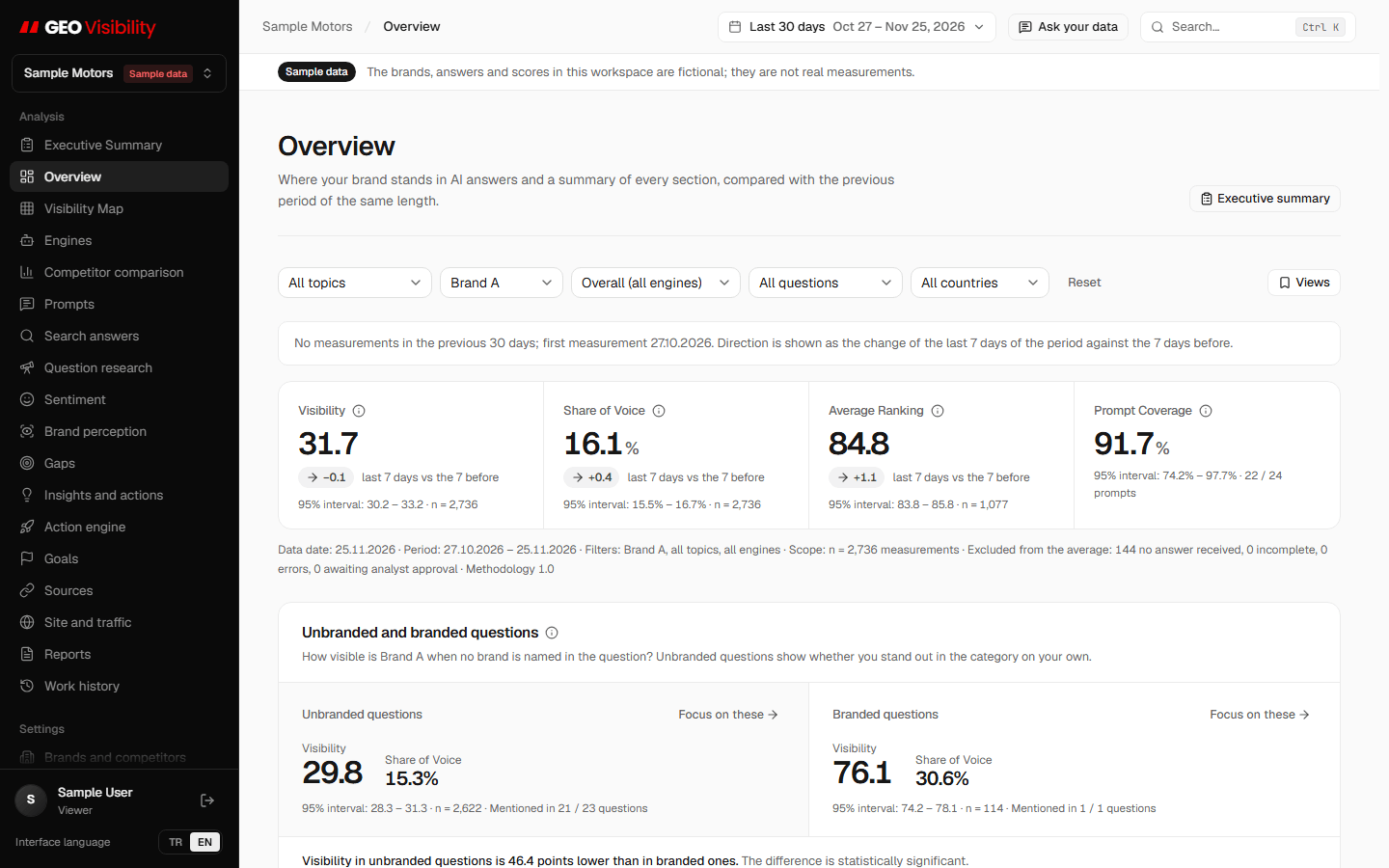
- 1
Filters for topic, brand, engine, question and country. Every score is recalculated for the selected scope.
- 2
The visibility score and its change. A sideways arrow means the change is not significant. Measurement began in this period, so the change compares the last seven days with the seven before.
- 3
Share of voice: Brand A's portion of all brand mentions in the same answers.
- 4
The confidence interval and number of measurements (n) for average ranking. The same line appears under every score.
- 5
Prompt coverage: the share of questions in which Brand A was named in at least one answer, with its confidence interval.
What is measured
- Visibility
- How often you are named and where you appear in the answer, combined in a single score. Its components, the number of measurements and the confidence interval are always shown beside it, and every figure links back to the raw answers.
- Share of voice
- Your share of mentions, and your competitors', within the same answers. Adding competitors does not change the number of measurements, since they are looked for in answers already collected.
- Average ranking
- Your position among the brands named in the answers where you appear. In list-style answers, the first few places draw most of the reader's attention.
- Prompt coverage
- The proportion of your question set in which you appear at least once. Questions where you never appear are listed separately, and that list is often where the work begins.
Screens in the panel
- Visibility Map
- Questions in rows, surfaces in columns. Each cell shows whether your brand was named for that question on that surface and, if it was not, which brand was named most often instead.
- Engines
- Which surface knows you, which one recommends whom, and which sites does each draw on? The surfaces side by side: mention rate with its confidence interval, average position when mentioned, the answers that cite your site and the brands each surface recommends most.
- Head to head
- Puts two brands side by side: for which questions both are named and for which only one, and which ranks higher when they appear in the same answer. A difference is called clear only when the confidence intervals do not overlap.
- Competitors from the answers
- You are not asked for competitors; brands named in the answers are tracked as competitors automatically. Different spellings of the same company, such as an abbreviation and the full name, can be merged into one brand, and any name you do not want on the list can be removed.
Which decision it helps
Where to focus?
You see, one by one, the topics and engines where you are absent, and can direct budget and effort to where you trail furthest.
Is the change real?
When a change is not statistically significant, the dashboard says so plainly, which keeps a single day's fluctuation from driving a change of strategy.
Where is the competitor ahead?
You stand next to your competitors on the same questions. The share-of-voice breakdown shows on which topic, and in which engine, the gap opens.
What this screen does not show
- Visibility says nothing about how the brand is described. A mention in a negative context raises the score just as a positive one does; tone and accuracy are measured on the Brand Perception screen.
- The score is bounded by the question set and tells you nothing about questions outside it, which is why the set is built with you around your sector.
- Visits to your site are not part of this screen. Whether visibility turns into traffic is tracked on the Site and Traffic screen, provided the connections are in place.
Visibility tells you how often the brand is named; share of voice, in whose company. The two need to be read together.
Frequently asked
- Is the visibility score a single number?
- The score is one number, but it never comes alone: its components, the number of measurements and the confidence interval are always next to it. From every number you can reach the raw answers behind it in one click.
- Why does the score change from day to day?
- AI does not give the same answer to the same question every time. That is why you should read the period and the confidence interval, not a single day.
- Are my competitors measured by the same rule?
- Yes. The panel has no setting, weight or manual score that changes a result in favour of a brand.
- How does share of voice differ from visibility?
- Visibility is the proportion of answers in which you are named. Share of voice is your portion of all the brand mentions in those answers. In a crowded category the first can be high while the second stays low.
- Why does the confidence interval matter so much?
- AI answers vary, and the same question can bring up different brands on different days. The interval shows how solid a measured value is given that variation, and it is what allows a real change to be told apart from noise.
- Are the engines combined into one score?
- The overview can read all engines together, but each engine's score is also shown on its own and the difference between them is never hidden. A brand can be strong in ChatGPT and absent from Google AI Overviews. The two situations call for different work, because the engines build their answers differently.
- How are the questions in the set chosen?
- Questions are written the way customers actually ask them; unbranded, comparative and category questions make up most of the set. The set is agreed with you during onboarding and approved by a GEO specialist. Changing it often weakens comparison between periods, so changes are made in batches and recorded.