Platform
How Does AI Describe Your Brand, and Is It Correct?
In what tone and on which topics does AI describe your brand, and is what it says correct? Tone, topic and claim checks with evidence sentences.
Short answer
Being mentioned is not enough; how you are mentioned counts too. The panel splits the tone of answers into positive, neutral and negative, shows what is said on which topic with an evidence sentence, and compares claims about your brand with the correct facts you enter. A wrong price, an old product or a campaign that does not exist lands in front of a specialist.
How AI describes your brand
Being named in an answer is only part of the picture. The same answer may call your brand "expensive but reliable" or say its "service is slow". The brand perception screen sorts what is said about you by topic and ties every judgement to an evidence sentence taken from the answer.
Accuracy is a separate question. An engine may state a two-year warranty, or quote a price from a promotion that has already ended. Claims of this kind are checked against the facts you record in the dashboard; a claim that contradicts a recorded fact goes onto the list of incorrect information, together with the engine, the date and the source page.
The AI does not apply the "incorrect" label on its own. The label comes only from facts you have entered, and every result is approved by a specialist. On topics with no recorded fact, the dashboard makes no ruling on right or wrong; it simply shows what was said. This distinction sets the perception screen apart from a reputation score: the aim is not to make the brand look good but to record what the AI actually says, with its evidence.
What to look at on the screen
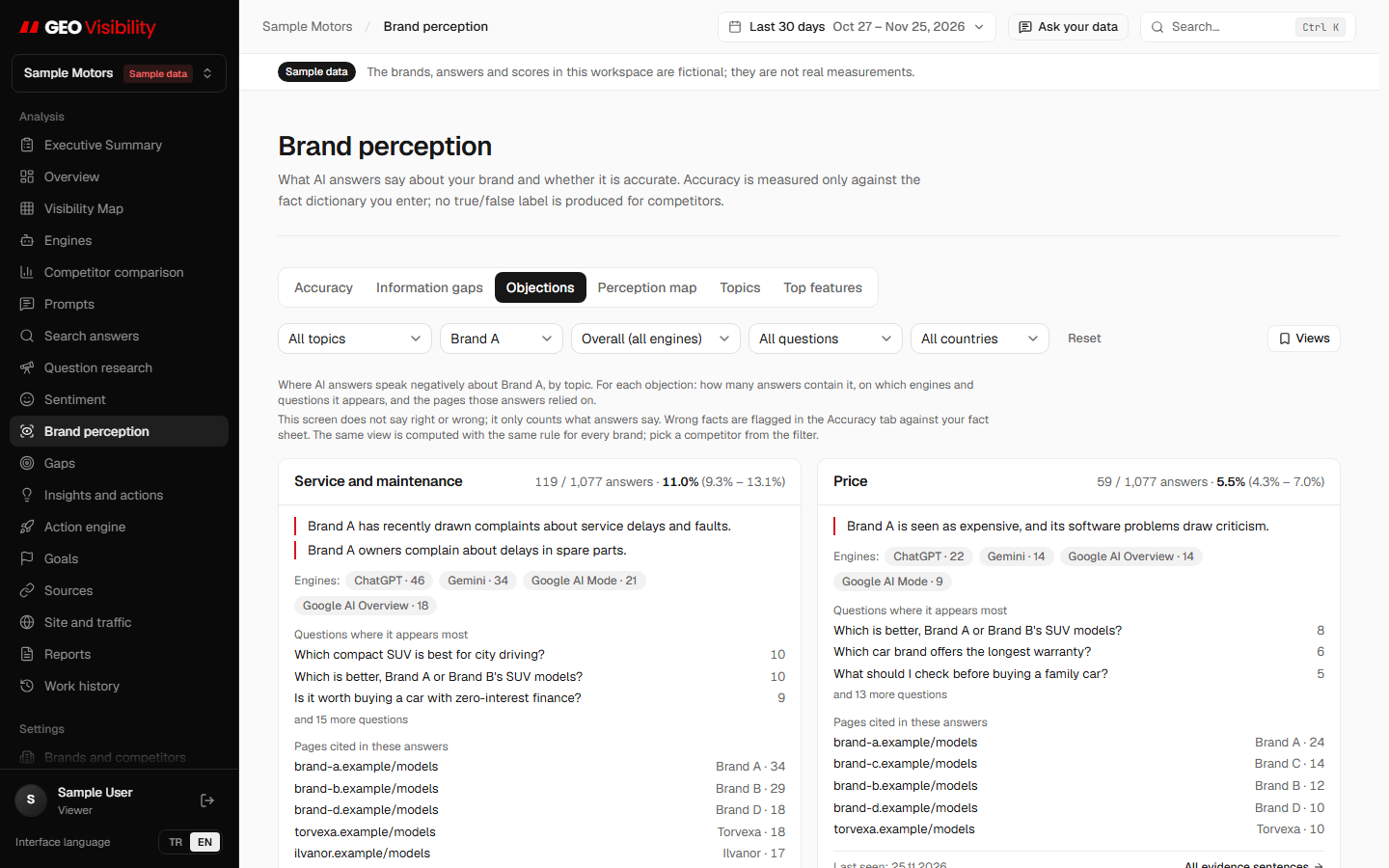
- 1
Tabs for accuracy, missing information, objections, the perception map, topics and highlighted features: six ways of reading the same answers.
- 2
Each objection is a topic: where the answers speak negatively about Brand A, how many answers it appears in, and the confidence interval.
- 3
Evidence sentences taken from the answers. This tab does not say true or false; incorrect information is listed on the accuracy tab, checked against the facts you record.
- 4
The pages cited in these negative answers, and whose site each one is. Corrections usually start from these pages.
What is measured
- Tone
- The split of positive, neutral and negative mentions. Each is stored with its evidence sentence, so you can move from a number to the words behind it.
- Perception by topic
- What AI attaches to your brand on topics such as price, quality and service, shown alongside what it attaches to your competitors on the same topics.
- Claim accuracy
- Whether factual claims in the answers agree with the facts you have recorded. Mismatches are listed with their frequency and the engines involved.
- Where the perception comes from
- Which source a negative judgement or a piece of incorrect information rests on, and therefore where a correction should begin.
Which decision it helps
Which error to fix first?
Incorrect claims are ranked by how often they recur and in which engines. The one repeated most rises to the top.
On which topic do we look weak?
Topics where competitors are praised and you are criticised become visible, and they feed straight into the content and communications plan.
Is our message getting through?
You can check whether the features you want to stress actually come up in the answers, and in which engines.
What this screen does not show
- The screen is only as reliable as your fact sheet. Incorrect information on a topic the sheet does not cover cannot be caught, which is why it needs to be kept current.
- No right-or-wrong labels are produced for competitors. Their tone and topics are shown, but their facts are not audited on your behalf.
- The dashboard does not correct the answer itself. It points to the source behind the error and to gaps on your own pages; the effect of a correction shows up in later measurements.
Frequently asked
- Who says a piece of information is "wrong"?
- The label comes only from the dictionary of correct facts that you enter. On a topic that is not in the dictionary, the panel does not say "wrong".
- Does AI decide the tone?
- AI helps read the answers; every result it extracts is approved by a specialist and stored with its evidence sentence.
- Can I correct something wrong that AI says?
- Not directly. But by correcting the source the error relies on and the missing information on your own pages, you can change the answer over time; the panel measures the effect.
- Which claims go onto the incorrect-information list?
- Only claims that can be checked against your recorded facts and that contradict them. Each comes with the engine, date, question, evidence sentence and source page, and a specialist approves it before it is listed.
- Can I see where a negative comment comes from?
- Yes. If a negative judgement rests on a source, that source is shown. Judgements without a cited source are flagged separately; they usually come from the model's own knowledge.
- Can perception be compared with competitors?
- Yes. Tone and recurring topics are read with the same rule for every brand. You see which feature your competitor is praised for and which topic you are criticised on, side by side. The comparison is not a ranking but a map of topics: it shows which theme works in whose favour.
- How long does it take for perception to change?
- Perception changes as the sources the engine relies on change. In engines that search the web, a new article or an updated page can reach the answers within weeks; in answers drawn from the model's own knowledge, the change may wait for the next model version. Because the same questions are asked every day, you see the day the change begins.
No judgement reaches a report without the sentence it rests on.