












Platform
How Is the Same Question Answered in Another Market and Language?
Your question set is split by market and language, and each market is scored on its own. The summary screen and reports state where the answers were collected.
Short answer
AI answers change from market to market and from language to language. The panel splits your question set by market and language; each market is scored on its own, and markets are never merged into one average. Answers are currently collected from a location in Türkiye, and the summary screen and reports say so. Because the Google surfaces can answer differently depending on location, results for questions aimed at another country are read with that note in mind.
Does the same question get the same answer everywhere?
It does not. Ask which compact SUV is safest for a family in Turkish from Turkey and in German from Germany, and the answers may name different brands in a different order. Engines take the user's language and location into account, and the sources behind an answer are usually local sites from that market.
Each market is therefore measured with its own question set and scored on its own. Markets are never blended into a single average, so a strong result in Turkey cannot mask a weak one in Germany. Questions are not translated; they are written the way people in that market actually ask.
One limit should be stated plainly: answers are currently collected from a location in Türkiye. The language of the question changes with the market; the collection location does not. Google AI Overviews and AI Mode are sensitive to location and may answer the same question differently when it is asked from another country. That is why the location is shown on the summary screen and in reports, and results aimed at another country are read with that note in mind. Read together, market and language show separately where you fall behind, and the task list is built at that level of detail.
What to look at on the screen
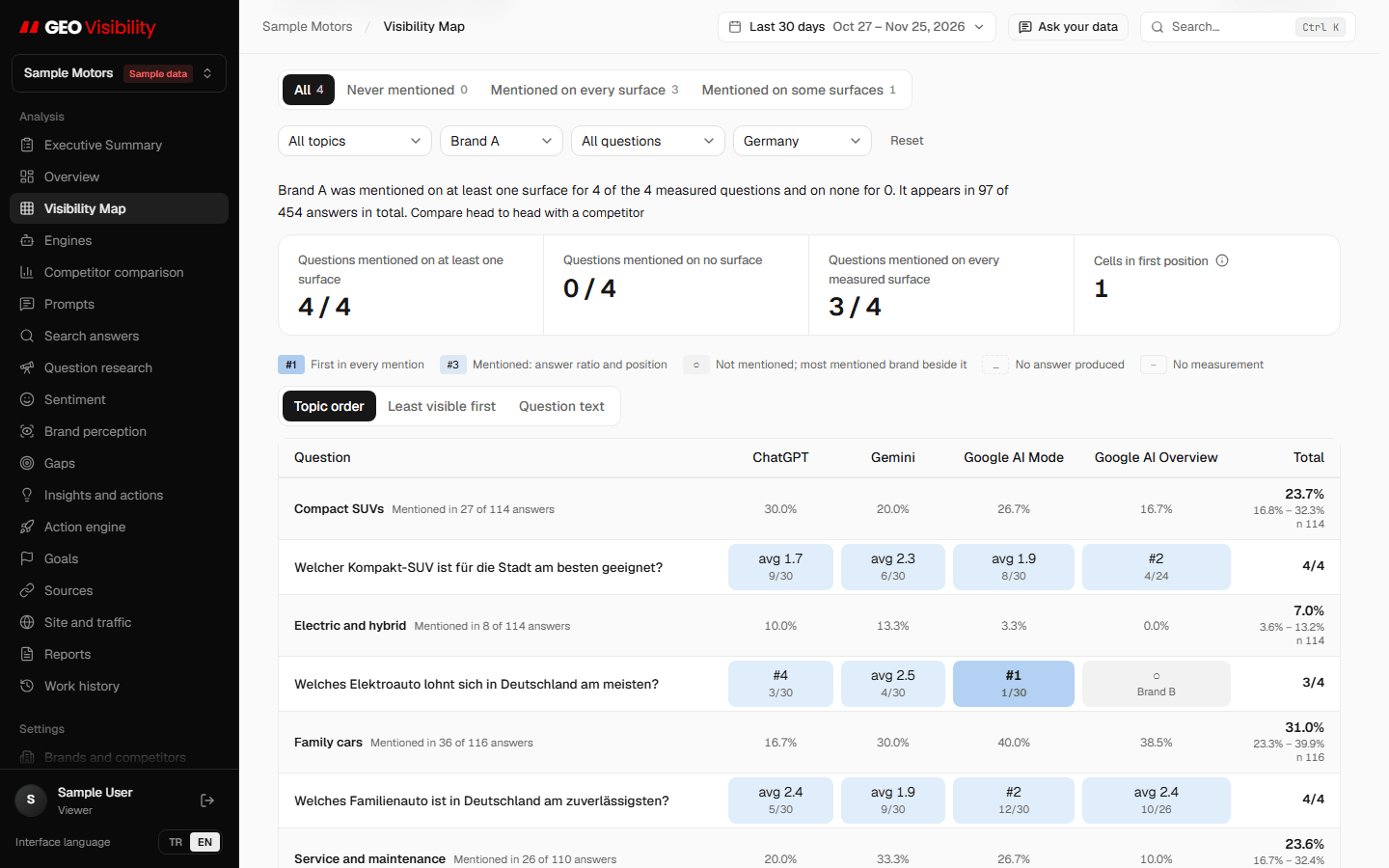
- 1
The country filter: every figure is calculated from that market's questions alone (Germany, here). Answers are collected from a location in Turkey, and the summary screen and reports say so.
- 2
A summary for the selected market: in how many questions you were named on at least one surface, and the total number of answers.
- 3
Questions are not translated; they are written in the market's own language. Each row is a question, each column an AI surface.
- 4
A cell: the number of answers naming you on that surface, and your average position. In a newly added market n is small.
- 5
A topic row: the market's mention rate for that topic, with its 95% confidence interval and number of answers.
What is measured
- Country and language
- Every market is measured with its own questions and scored on its own. Markets are not combined into one average.
- Collection location
- Answers are currently collected from a location in Türkiye. The location is shown on the summary screen and in reports, and questions aimed at another country are read with that in mind.
- Market comparison
- The same brand's visibility and competitive rank across countries, side by side.
- Local sources
- The local sites that answers rely on in each market. The source gap is read separately for each market too.
Which decision it helps
In which market are we not visible?
The country where you are strong sits next to the one where you are weak, and that contrast guides which market gets the investment.
How are we described in each language?
The gap between the answers that questions on the same topic receive in different languages shows in which language your message is weak.
Is local content needed?
If answers in a market lean heavily on local sources, translating your site will not be enough; that market needs local content and local outreach.
What this screen does not show
- Only markets that are measured appear here. No estimates are produced for a country without a question set.
- Comparisons across markets are not like for like, because the question sets differ. They are best made on rank and trend rather than on absolute figures.
- Answers are currently collected from a location in Türkiye. For questions aimed at another country, and on the Google surfaces in particular, a user in that country may see a different answer.
Frequently asked
- How many countries can I measure?
- The number of countries depends on your plan. Each country is measured with its own question set.
- Where are the answers collected from?
- Today every answer is collected from a location in Türkiye, and the summary screen and reports say so. Questions are written in the market's language. Because the Google surfaces can answer differently depending on location, results for questions aimed at another country are read with that note in mind.
- Is translating the questions enough?
- Usually not. People ask differently in each market; the question set is built in that market's language and habits.
- When can I trust the results for a newly added market?
- In the first days there are few measurements, so the confidence interval is wide, and the dashboard shows it. The interval narrows as measurements accumulate; judge the figures by how narrow it has become.
- Why can the gap between markets be so large?
- Engines take the user's language and location into account and usually build answers from local sources. Without strong local sources in a market, strength elsewhere does not carry over.
- Can I merge markets into one score?
- The panel deliberately does not. Markets differ in their question sets, competitors and engine usage; a single average lets the large market overshadow the small one. Markets are read side by side, each with its own confidence interval.
- Are the competitors the same in every market?
- Not necessarily. The competitive ranking is calculated separately for each market. You are not asked for competitors; brands named in the answers are tracked as competitors automatically, so a brand that leads in one market may not appear in another at all. You can remove any name you do not want on the list.
A strong result in one market should never be allowed to hide weakness in another inside an average.